For most people, scheduling an appointment with a dentist is not an impulse buy or a purely logical transaction. It is deeply rooted in fear, vulnerability, and the search for safety. Dentistry is one of the few medical disciplines where the patient remains completely conscious while a professional operates sharp instruments in a highly sensitive zone of their body: their face.
Consequently, the decision to choose one clinic over another does not come down to who has the lowest price or the most modern website. It boils down to the architecture of trust. Dental practices that achieve a steady flow of new patients do not just optimize their technical SEO; they optimize their communication to align with consumers' cognitive biases. Understanding consumer psychology is the missing link between a digital marketing strategy that generates mere clicks and one that predictably fills a clinic’s appointment book.
The Trust Deficit: Overcoming Dental Anxiety Through Digital Architecture
The first and largest obstacle facing any dental marketing campaign is fear. Dental anxiety (or odontophobia) affects a massive percentage of the global population. When a potential patient searches for a term like "best cosmetic dentist near me" on Google, their subconscious brain is running a defense mechanism: it is actively scanning for safety signals to mitigate that anxiety.
If a clinic's website displays raw clinical imagery, intimidating surgical instruments, or a cold, institutional design, the user's brain triggers an instant rejection response. Website design and content strategy must act as a digital anxiety relief tool.
-
The Radiograph vs. The Smile: Clinical vs. Emotional Imagery
Many clinics make the mistake of filling their websites with close-up photographs of surgical procedures, bleeding gums, or exposed implants. They believe this demonstrates clinical competence. In reality, it has the exact opposite effect on the average patient. The human brain processes images 60,000 times faster than text. At the sight of metal and blood, the amygdala fires up, associating the clinic with pain.
Psychological optimization demands the use of lifestyle imagery, friendly human faces, brightly lit spaces that resemble a wellness spa, and environments that convey comfort. Medical competence is proven through credentials, clear copywriting, and testimonials, not by scaring the patient before they even walk through the door.
-
The Power of Radical Transparency in Pricing and Procedures
Uncertainty is the fuel of anxiety. When potential patients do not understand what will happen during a treatment or how much it will cost, they prefer to postpone the decision. Clinics that implement detailed service pages, explaining a procedure step-by-step (such as the process of porcelain veneers or clear aligners) without complex medical jargon, succeed in demystifying the experience. Explaining "what to expect" reduces the psychological friction of the fear of the unknown, turning informational Google searches into real conversions.
Cognitive Biases in Action: How Patients Evaluate Dental Competence
The average consumer does not have a degree in dentistry, meaning they cannot objectively evaluate a dentist's technical skill. They do not know if a crown preparation margin is flawless or if the bone density after a graft is ideal. How do they judge a dentist's quality then? They do it through the transfer of attributes using mental shortcuts known as cognitive biases. If a clinic’s digital marketing looks professional, is easy to use, and conveys warmth, the patient’s brain automatically assumes that the dentist's clinical work will be equally professional, precise, and gentle.
-
The Halo Effect and First Impressions in Local SEO
The Halo Effect is a cognitive bias where the perception of a specific trait of a person or brand influences the overall judgment of them. In the digital environment, the Google Business Profile and the first 3 seconds on a website serve as the clinic's "tailored suit." If an office appears in Google's coveted Local Pack with an immaculate profile, high-definition photographs of the facilities, and a seamless booking process, the user assumes the medical care will be top-tier. A slow, outdated, or mobile-unfriendly website transfers an unconscious signal of neglect and obsolete technology.
-
Authority Bias: Position Your Doctors as Key Opinion Leaders
Human beings are conditioned to trust authority figures. To activate this bias in favor of the clinic, the SEO content strategy must go beyond simply listing services offered. It must build detailed doctor profiles highlighting specializations, memberships in prestigious academies (like the AACD or ADA), successful before-and-after case studies, and participation in international conferences. When content demonstrates that a dentist does not just practice the profession but actively educates others in their field, the barrier of distrust collapses.
Social Proof and the Pack Mentality in Dental Selection
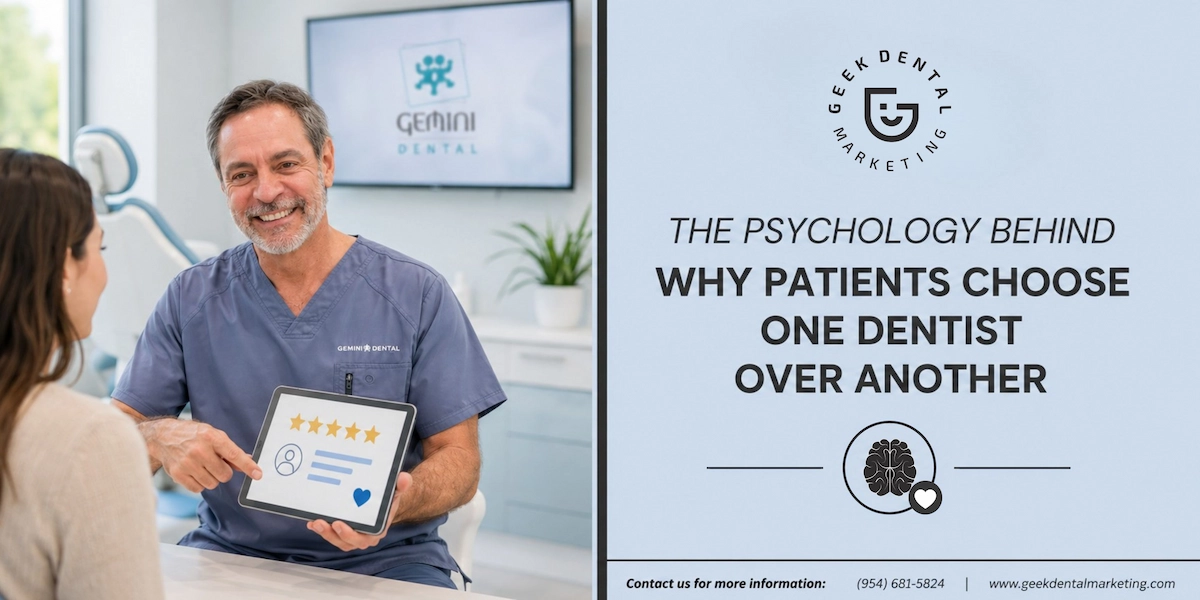
When faced with uncertainty, we look to others to determine the correct action. This principle of Social Proof is the foundational pillar of reputation marketing. A patient will rarely choose a dentist based solely on what the dentist says about themselves in their advertising; they choose based on what other patients say about their actual experience. The volume, consistency, and narrative of digital reviews are the number one deciding factor in converting high-value patients.
-
Micro-Narratives: Turning Star Ratings into Emotional Stories
A list of fifty reviews that only say "Good dentist, highly recommend" helps the local SEO algorithm, but it does not connect emotionally with a potential patient suffering from pain or aesthetic insecurity. The most powerful reviews are those that construct a micro-narrative of transformation. For example, a review where a patient details how they used to cover their mouth when laughing due to misaligned teeth, and how a "smile makeover" at the clinic restored their confidence to apply for a new job, triggers deep empathy in the reader. The marketing strategy must educate and incentivize patients to leave structured reviews that address future clients' doubts.
-
The Bandwagon Effect: Creating FOMO Around Your Practice
The Bandwagon Effect dictates that people tend to do things simply because they see others doing them. Displaying real-time counters or statistical data on the website (such as "Over 5,000 smiles transformed in our community" or "The local community's choice for orthodontics for over 10 years") socially validates the user's choice. It reduces perceived risk: if thousands of people trust this clinic, the probability of having a bad experience is minimal.
The Role of Hyper-Local Relevance and Digital Convenience
Modern psychology is obsessed with the elimination of friction. We live in the era of instant gratification, where services like Uber and Amazon have conditioned consumers to expect everything to be accessible a single click away. In the dental health sector, this behavior translates into two strict psychological demands: geographic proximity and operational convenience. If the scheduling process is cumbersome or the office feels distant and inaccessible, the patient will choose an option they perceive as more convenient, even if it has slightly lower ratings.
-
Proximity Psychology: Dominating the "Near Me" Mindset
The human brain calculates effort before making a decision. When someone searches for an "emergency dentist near me," they are not just looking for metric distance; they are looking for viability. Local SEO must be structured using geolocalized landing pages that mention local landmarks, specific neighborhoods, and accessible transit routes. By doing this, the clinic positions itself mentally as the most logical and convenient option within the patient's daily routine (near their home, work, or their children's school).
-
Eliminating Decision Fatigue with Frictionless Conversions
Decision fatigue occurs when a user is bombarded with too many options or complex steps to complete a task. A dental website that forces a user to fill out endless medical history forms before they can even see appointment availability destroys the conversion rate. To optimize the psychological experience, the call to action (CTA) must be unified, highly visible, and absurdly easy to execute: a single button to book online directly integrated with the clinic’s software, or a direct click-to-call button that solves their problem with one tap.
How Dental Marketing Agencies Decode Patient Behavior for Growth
The successful implementation of these psychological triggers requires a technical infrastructure that most independent dentists lack the time or technical knowledge to develop. This is where an agency specializing in dental marketing makes the difference between an office struggling to fill empty slots and a thriving practice expanding its facilities due to high demand.
An expert agency does not stop at buying Google Ads or writing generic keyword-stuffed blogs. They audit every single digital touchpoint of the patient journey, from website loading speeds to metadata optimization and the creation of highly structured conversion funnels for specific high-margin treatments, like All-on-4 dental implants or advanced cosmetic dentistry. By aligning technical SEO with consumer psychology, they generate a sustainable, long-term return on investment (ROI).
Frequently Asked Questions (FAQs)
How does local SEO influence a patient’s psychological trust in a dentist?
Local SEO influences trust through the availability heuristic and the halo effect. When a clinic consistently appears at the top of Google Maps and organic search results for critical health queries, the patient's brain equates high digital visibility with real-world medical excellence and established institutional reputation.
Why do patient reviews impact dental conversion rates more than traditional advertising?
Patient reviews act as organic social proof. Modern consumers have developed ad blindness toward paid promotions. Third-party experiences provide an unbiased validation of the practice's promise, effectively reducing the perceived risk and anxiety associated with dental treatments.
What visual elements should a dental website include to reduce patient anxiety?
A dental website should include bright, high-lighting lifestyle imagery, real photos of the medical staff smiling in welcoming attire, high-definition tours of relaxing waiting areas, and calm video walkthroughs to guide the patient through the facility before their actual visit.
How long does it take for a dental marketing campaign to generate qualified leads?
A comprehensive, well-optimized campaign typically shows initial lead generation via paid search (PPC) within the first 30 days. For organic dental SEO strategies and authoritative content placement, exponential growth and a sustainable patient flow usually solidify between 4 to 6 months.
Is online appointment scheduling critical for patient acquisition?
Yes, it is critical for eliminating decision fatigue and matching convenience psychology. Over 40% of patients prefer scheduling appointments outside of standard business hours. Lacking an automated online booking channel means losing substantial conversions to more accessible competitors.
Lead the Dental Market with Geek Dental Marketing
Optimizing your clinic's digital presence to align perfectly with a patient's psychological decision-making process requires a surgical focus and impeccable technical execution. If your office is not attracting the volume of patients your clinical expertise deserves, the issue isn't your skill as a dentist; it is your digital visibility and conversion architecture.
At Geek Dental Marketing, we understand with scientific precision how patients think, what they look for on Google, and what drives them to choose one dental clinic over the rest of the market in Florida. We develop tailored local SEO strategies, conversion rate optimization, and high-impact medical branding to transform your practice's digital footprint into a predictable patient acquisition engine.
Stop letting high-value patients book with your competitors. Put your practice in the hands of medical digital growth experts.
- Company Name: Geek Dental Marketing
- Location: 1395 Brickell Ave Suite #800, Miami, FL 33131, United States
- Phone Number: 954-681-5824
- Website: Geek Dental Marketing
Take the next step toward practice growth. Call us today at 954-681-5824 to book your comprehensive digital footprint audit.