
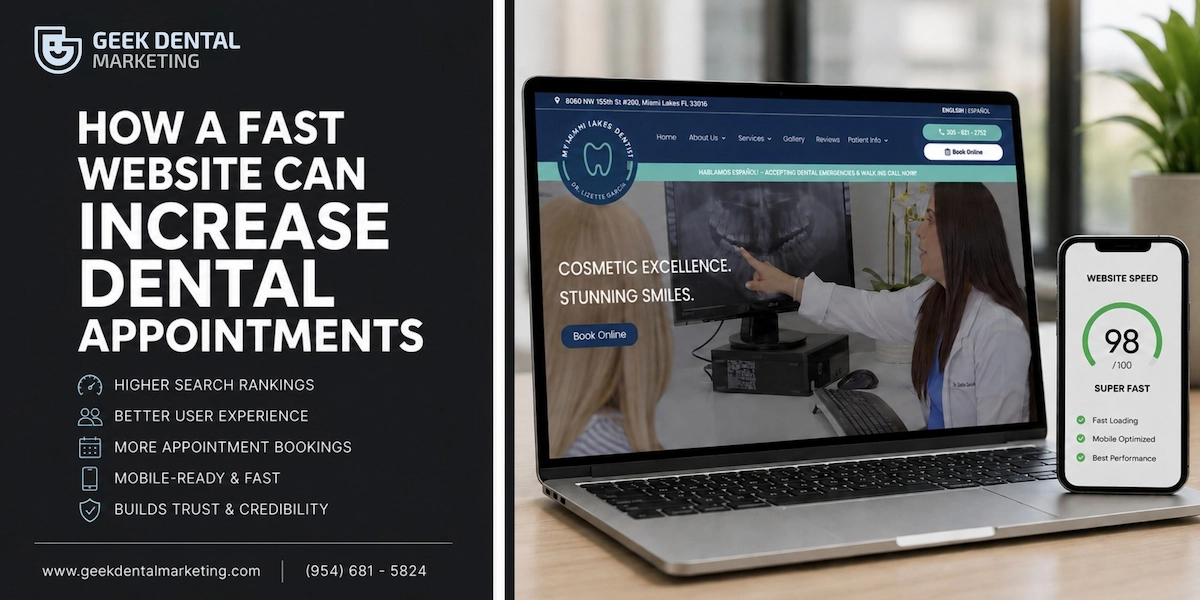
In the competitive landscape of digital healthcare marketing, attracting potential patients to your dental practice’s website is only half the battle. The true turning point lies in what happens during the first three seconds of their visit. For many dental practices, a high bounce rate, where users leave the site almost immediately, is not a reflection of poor clinical reputation, but a direct consequence of a sluggish digital infrastructure. A fast website is no longer just a technical luxury; it is a foundational patient acquisition tool that directly influences your search engine visibility, user experience, and monthly conversion rates. When a patient is experiencing acute dental pain or searching for an aesthetic smile makeover, they demand instant solutions. If your platform fails to load rapidly, they will simply return to the search results and click on a competitor whose digital doorstep is more welcoming.
To understand why speed dictates financial performance in local dental SEO, one must look at the psychological state of the healthcare consumer. Patients seeking dental care online typically fall into two categories: emergency cases needing immediate relief, and high-value elective cases, such as those seeking porcelain veneers or clear aligners, who are meticulously evaluating their options. In both scenarios, friction in the user journey leads to abandonment. Slow loading times signal a lack of professionalism and structural neglect, which subconsciously erodes the trust a patient needs to establish before booking an invasive clinical procedure. By treating website speed as a core marketing metric, dental practices can transform their online presence from a static digital brochure into an optimized, high-conversion patient enrollment funnel.
The Direct Link Between Page Speed and Dental Conversions
The correlation between technical web performance and patient acquisition can be mapped precisely through user behavior metrics. In digital marketing, conversion rate optimization (CRO) relies heavily on removing psychological and technical barriers. When a website loads under two seconds, the user experiences a fluid, uninterrupted stream of information that guides them naturally from educational content to your online booking widget. Conversely, data consistently shows that every additional second of load time cuts conversion rates by an average of 7 to 10 percent. For a clinic aiming to generate 50 new patient leads per month through organic search, a three-second delay can silently drain thousands of dollars from their potential revenue pipeline by driving qualified traffic away before an interaction even occurs.
Consider a real-world scenario involving a high-ticket treatment like dental implants. A prospective patient searches for local implant specialists, encounters your highly informative blog post, and clicks the link. If the page stalls because of uncompressed panoramic images or poorly executed JavaScript blocks, the patient’s initial enthusiasm transforms into frustration. In healthcare marketing, frustration is an immediate conversion killer. The user assumes that if a clinic cannot maintain a functional website, their attention to detail in clinical sterilization, patient care, or advanced digital dentistry might be equally compromised. Speed builds immediate, unspoken equity with the user, reassuring them that your practice operates with efficiency and cutting-edge precision.
Furthermore, a rapid website directly amplifies the ROI of all your secondary marketing channels. Whether you are running localized Google Ads campaigns, driving traffic from social media platforms, or deploying email newsletters to your existing patient database, the destination page must perform flawlessly. If you pay for a premium click via pay-per-click (PPC) advertising, but that traffic bounces due to a five-second loading screen on a mobile browser, you are effectively subsidizing your competitors' market share while inflating your own cost-per-acquisition (CPA). Speed ensures that the traffic you work hard to earn actually arrives, stays, and converts into an active patient on your schedule.
Why Google Penalizes Slow Dental Websites in Local Search
Google's primary objective as a search engine is to deliver the most relevant, helpful, and technically seamless results to its users. To enforce this, the search algorithm incorporates technical performance metrics known as Core Web Vitals into its core ranking system. These indicators measure real-world user experience for loading performance, interactivity, and visual stability of the page. If your dental website exhibits poor metrics across these vitals, Google’s crawling bots categorize your site as a low-quality user experience, systematically suppressing your visibility in both the standard organic results and the highly lucrative Google Local 3-Pack.
Understanding the Metrics That Dictate Your Rank
To diagnose and repair an underperforming dental website, you must understand the specific technical diagnostic markers that search engines analyze:
- Largest Contentful Paint (LCP): This metric tracks the time it takes for the primary visual content of a webpage, such as your main hero banner or headline, to become fully visible to the user. An optimal LCP is 2.5 seconds or faster. In many dental websites, heavy, unoptimized stock photos of pristine smiles drag this metric into dangerous territory, signaling to Google that the page is unresponsive.
- First Input Delay (FID) / Interaction to Next Paint (INP): These metrics quantify the responsiveness of your site when a user first attempts to interact with it, such as clicking an "Online Booking" button or expanding a dropdown menu. If the browser's main thread is blocked by heavy background scripts, the user experiences a jarring freeze. An ideal response time is 100 milliseconds or less.
- Cumulative Layout Shift (CLS): This measures visual stability by tracking unexpected layout shifts while the page is loading. For example, if a patient attempts to click a phone number link, but an image or banner suddenly loads late and pushes the text downward, causing them to click an ad or an incorrect link by mistake, the CLS score spikes. Your target score should be 0.1 or less.
When a medical or dental website fails these benchmarks, its organic positioning degrades. This is particularly devastating for local SEO, where patients are looking for immediate solutions. If your competitors have invested in specialized medical web development that prioritizes clean code execution and rapid server responses, their websites will naturally climb above yours in local map packs. Google understands that a mobile user searching for an "emergency dentist near me" cannot afford to wait for an unoptimized site to parse data; therefore, the search engine prioritizes fast-loading platforms to protect its own user retention.
Mobile Optimization: Where 70% of Your Patients Begin Their Search
The modern patient journey does not take place behind a desktop computer; it unfolds dynamically on smartphones while users are commuting, working, or managing family schedules. Across our extensive data architecture managing digital campaigns, we consistently observe that over 70% of organic traffic to local dental practices originates from mobile devices. This shift in consumer behavior means that your mobile website variant is your actual primary storefront. If your digital marketing strategy treats mobile optimization as a secondary afterthought, you are alienating the vast majority of your prospective patient base.
Mobile browsing presents unique technical challenges that desktop environments do not face. Smartphones frequently rely on cellular networks (4G or 5G) which can experience sudden drops in bandwidth, and mobile processors are significantly less powerful than desktop hardware. A website that loads acceptably on a high-speed office fiber-optic network may completely stall on a patient's phone inside a moving vehicle or a crowded commercial space. Mobile optimization requires a radical reduction in page weight, the elimination of invasive pop-up elements that obstruct touch navigation, and the utilization of responsive styling that formats perfectly across all screen dimensions.
When a mobile user lands on a rapid, responsive dental site, their path to conversion is effortless. The phone number is configured with a native click-to-call protocol, the navigation menu collapses into a clean, thumb-accessible layout, and the interactive appointment calendar operates smoothly without freezing the screen. This level of technical execution removes all cognitive friction. The patient can discover your clinic, evaluate your credentials, check your location, and finalize an appointment request within a single three-minute browsing session while waiting in line at a local coffee shop. That is the power of a modern mobile-first conversion funnel.
Technical Auditing: The Blueprint for a High-Performance Dental Site
Achieving lightning-fast speeds requires moving past generic content management system templates and executing precise, professional backend adjustments. Most dental websites suffer from structural bloat caused by over-reliance on third-party plugins, excessive tracking scripts, and improperly formatted media files. To transform a slow site into an optimized search engine asset, a systematic technical audit and optimization campaign must be executed.
1. Comprehensive Image Compression and Modern Formatting
Dental sites are inherently visual; patients want to see clean clinical environments, professional headshots, and before-and-after smile transformations. However, uploading raw high-resolution photographs straight from a digital camera will instantly degrade your load speeds. All images must be processed through compression algorithms that eliminate unnecessary metadata without sacrificing visual clarity. Furthermore, traditional formats like JPEG and PNG should be migrated to modern next-generation formats such as WebP or AVIF, which deliver identical visual fidelity at a fraction of the file size.
2. Implementation of Lazy Loading Protocols
Not every element of a long-form landing page or educational article needs to load the exact millisecond a user clicks your link. By implementing native lazy loading, you instruct the web browser to prioritize the rendering of above-the-fold content (everything visible on the immediate screen). Images, testimonials, maps, and detailed footer elements located further down the page are only loaded as the user actively scrolls downward. This drastically decreases the initial page weight and ensures your structural LCP remains within Google's preferred parameters.
3. Minification and Consolidation of Code Assets
Behind the visual design of your website lies thousands of lines of HTML, CSS, and JavaScript. Over time, as changes are made, this code becomes cluttered with redundant spaces, developer notes, and unused formatting instructions. Minification is the technical process of stripping away this digital waste to make the file sizes as small as possible. Additionally, combining scattered script files into centralized style sheets reduces the number of individual HTTP requests a user's browser must submit to your hosting server, speeding up the rendering pipeline significantly.
4. Advanced Caching Strategies and Content Delivery Networks (CDNs)
When a user visits your website, their device has to pull data directly from a physical server location. If your practice is in South Florida, but your web hosting server is located in an overseas data center, that spatial distance creates structural latency. By leveraging a high-performance Content Delivery Network (CDN), static copies of your website assets are cached and distributed across a global network of servers. When a patient in your local neighborhood looks for your services, the data is served from the closest geographical node, resulting in near-instantaneous load times.
Strategic Action Plan: How to Transition Traffic into Active Patients
A technically perfect website is an exceptional asset, but it must be paired with an intuitive user experience to maximize appointment volume. Once your page speed is optimized, the user flow must guide the patient toward your primary conversion metrics with absolute clarity. The design should feature prominent, highly visible call-to-action (CTA) zones that stand out contrastingly against your primary branding colors.
For modern dental clinics, offering a multi-channel communication approach is essential. While tech-savvy patients prefer using self-service digital scheduling platforms where they can view available time slots in real-time, emergency patients or elderly demographics frequently prefer direct voice interaction. Your contact infrastructure must cater to both profiles simultaneously. This means integrating automated text-to-book capabilities, prominent click-to-call links across every header, and a streamlined, secure contact form that asks for essential information without creating filling fatigue.
Ultimately, optimizing your website speed and structural user journey is a long-term investment in your practice’s independent digital infrastructure. Instead of relying indefinitely on expensive, fluctuating paid advertising networks, a fast, highly rankable organic website builds a self-sustaining patient acquisition ecosystem. It continuously captures local high-intent search traffic, establishes professional trust through a flawless digital experience, and systematically converts anonymous online browsers into loyal, long-term patients for your practice.
Frequently Asked Questions (FAQs)
1. How does website speed specifically impact my local dental SEO rankings?
Website speed is a direct ranking factor used by Google’s algorithm through the Core Web Vitals framework. If your dental website takes too long to render its content or experiences layout shifts during loading, Google will de-prioritize your platform in local organic searches and map packs. A faster website ensures search engine crawlers can index your pages efficiently, while low bounce rates signal that your site provides a high-quality user experience worthy of top-tier positioning.
2. What is an ideal loading time for a modern dental website to prevent patient drop-off?
The industry gold standard for optimal user retention is under 2 seconds. Data indicates that consumer patience drops significantly after the three-second mark; a delay from one to three seconds increases the probability of a bounce by over 32%. Keeping your platform fast ensures you retain emergency patients who require immediate medical responses, as well as cosmetic patients who demand a seamless browsing experience.
3. Will optimizing my website speed help reduce my cost per patient acquisition on Google Ads?
Yes, website speed heavily impacts your Google Ads Quality Score. When you direct paid traffic to a fast-loading, highly relevant landing page, your bounce rates decrease and your user engagement metrics improve. A higher Quality Score lowers your average Cost-Per-Click (CPC), meaning you spend less ad budget to achieve top-tier visibility, effectively driving down your overall patient acquisition costs.
4. What are the main culprits causing my dental website to load slowly?
The most common technical issues causing slow performance include massive, uncompressed high-resolution images, excessive use of unoptimized third-party plugins, unminified Javascript and CSS files, and outdated web hosting servers. Integrating heavy interactive elements, such as un-optimized embedded patient forms or uncompressed video backgrounds, also significantly degrades initial page rendering speeds.
5. Do I need a completely new website to improve my loading speeds, or can my current site be optimized?
In many cases, an existing dental website can be dramatically accelerated through professional backend technical remediation, such as migrating to modern WebP image formats, implementing advanced caching strategies, minifying code, and utilizing a Content Delivery Network (CDN). However, if your site was built on an archaic, bloated theme framework, a clean, modern web development overhaul may be recommended to establish a high-performance, mobile-first architectural foundation.