
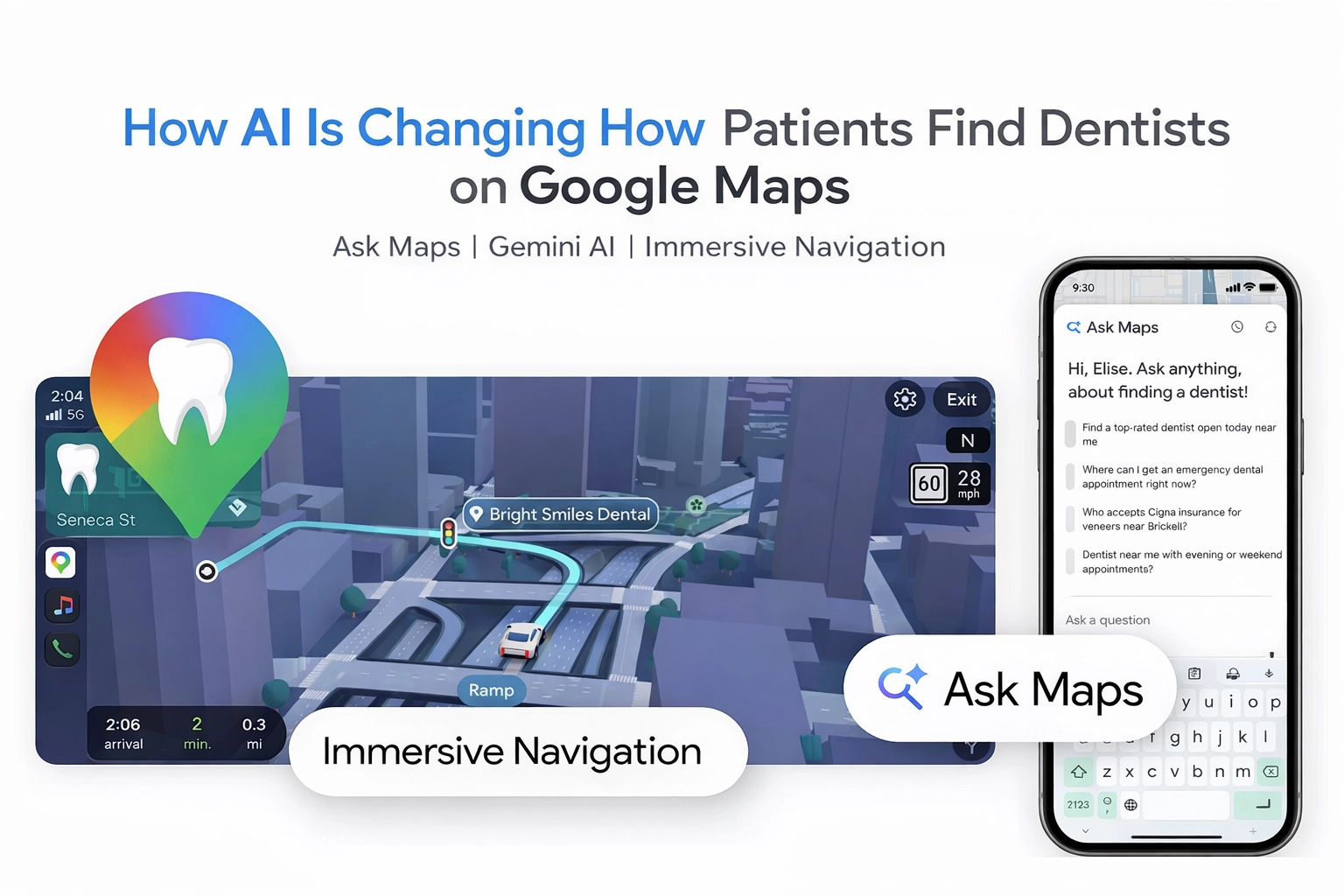
Google is redefining how people explore the world, discover businesses, and navigate daily life. With the introduction of Ask Maps and Immersive Navigation, powered by advanced Gemini AI models, Google Maps is evolving from a simple navigation tool into a powerful AI-driven discovery platform.
For dental practices, this shift will have a profound impact on how patients search for dentists, evaluate options, and ultimately choose where to receive care. The traditional search experience—where users type short keywords and browse through lists of businesses—is rapidly transforming into something far more conversational, contextual, and intelligent.
At Geek Dental Marketing, we closely analyze every major Google update because changes like this influence how patients discover dental offices online. These innovations will reshape the future of dental SEO in Miami, local search visibility, and digital marketing strategies for healthcare providers.
Understanding how these systems work allows dental practices to position themselves ahead of the curve while others struggle to adapt.
The Evolution of Google Maps: From Directions to Intelligent Discovery
When Google Maps first launched, its primary function was simple: helping people get from one place to another. Over time, it expanded to include business listings, reviews, and local recommendations.
Today, Google Maps has evolved into one of the most powerful local search platforms in the world. Millions of people rely on it daily to find restaurants, services, medical providers, and retail stores.
Now, with the integration of Gemini AI models, Google Maps is entering a new phase.
Instead of simply presenting information, Maps can now understand complex questions and deliver intelligent answers.
This means that when someone searches for a dentist, Google Maps will not simply display a list of offices. Instead, it will analyze a wide range of information sources to recommend the most relevant options.
This transformation changes everything about how patients discover dental providers.
Introducing Ask Maps: Conversational Search for Real-World Questions
Ask Maps is one of the most significant innovations introduced by Google in recent years. Rather than requiring users to search using simple keywords, Ask Maps allows people to interact with the map using natural language questions.
Users can ask questions such as:
- “Is there a dentist near me open tonight?”
- “Where can I find a cosmetic dentist with great reviews near Kendall?”
- “Which dental office near me offers Invisalign and has weekend appointments?”
- “Where can I find a dentist that accepts my insurance and is close to my job?”
These types of complex questions were previously difficult for search engines to answer. Users often had to search multiple times, browse several websites, and compare different providers.
With Ask Maps, Google can analyze large amounts of data instantly and provide a conversational response along with a visual map showing recommended locations.
This dramatically simplifies the patient’s journey.
Instead of performing multiple searches, patients can simply ask one question and receive a curated list of options tailored to their needs.
How Gemini AI Powers Ask Maps
The technology behind Ask Maps is Google’s advanced Gemini AI model, which is designed to process and understand complex queries.
Gemini integrates multiple types of information to generate intelligent responses. These include:
- Google Business Profile data
- Website content
- Street View imagery
- Real-time location data
- Community reviews
- User behavior signals
- Traffic patterns
- Geographic context
Unlike older search systems that relied heavily on keywords, Gemini understands context and intent.
For example, when a patient asks:
“Where can I find a dentist near me that does veneers and has great reviews?”
The AI system evaluates multiple signals at once.
It identifies dental offices offering veneer services, analyzes review sentiment related to cosmetic dentistry, considers proximity to the user, and filters results based on relevance.
The final response includes both information and visual guidance, making it easier for the patient to make a decision.
This is a significant shift because search engines are no longer simply retrieving information—they are interpreting it.
Beyond Reviews: AI Uses Multiple Data Sources
Many people assume that Google Maps recommendations are based mainly on reviews. While reviews are still important, modern AI systems use many additional signals to determine which businesses appear in recommendations.
Gemini models evaluate factors such as:
- Accuracy of business information
- Website authority and content
- Services listed on the business profile
- Photos and visual signals
- User engagement with the listing
- Geographic proximity
- Real-time traffic and accessibility
This means that even if a dental office has strong reviews, it may still struggle to appear in AI recommendations if its website and business profile lack detailed information.
For dental practices, this highlights the importance of having well-structured content that clearly communicates services and expertise.
Why This Matters for Dental SEO
As Google Maps becomes more intelligent, traditional search engine optimization must evolve as well.
Dental practices must now optimize their digital presence not only for search engines but also for AI interpretation.
This includes ensuring that Google can clearly understand:
- What services the practice offers
- Where the office is located
- What procedures are available
- What patients say about their experience
- How the office compares to competitors
Practices that invest in strong dental marketing in Miami will be far more likely to appear when AI systems recommend local providers.
For example, if a patient asks:
“Where can I find a dentist near me that specializes in smile makeovers?”
Google’s AI will scan local dental websites and profiles to identify practices that mention smile makeovers, cosmetic dentistry, veneers, and related procedures.
Practices that clearly communicate these services online will be prioritized.
Immersive Navigation: A New Way to Reach Your Dental Office
In addition to improving search and discovery, Google is also transforming the driving experience with Immersive Navigation.
This update introduces a dynamic 3D environment that shows buildings, roads, and landmarks in much greater detail.
Instead of relying on a simple map interface, drivers now see a realistic representation of their surroundings.
This includes:
- Buildings and structures
- Road lanes and intersections
- Traffic lights and stop signs
- Crosswalks and medians
- Nearby landmarks
The goal is to make navigation more intuitive and reduce confusion when approaching complex intersections or unfamiliar destinations.
For dental offices located in busy urban areas like Miami, this feature can make it easier for patients to locate the correct building and parking area.
The Importance of the “Final Mile” Experience
One of the biggest frustrations patients experience when visiting a new location is navigating the final part of the journey.
Patients often struggle with questions like:
- Which side of the street is the building on?
- Where is the entrance?
- Where can I park?
Immersive Navigation addresses these challenges by providing additional visual guidance as the driver approaches the destination.
The system may highlight the building entrance, show nearby parking options, or indicate which side of the street the office is located on.
For healthcare providers, this improvement reduces the likelihood of patients arriving late or missing appointments due to navigation confusion.
The Growing Role of AI in Local Search
Google Maps processes an enormous amount of data every second.
According to Google, the system integrates millions of real-time traffic updates and user contributions daily.
Community members report accidents, construction zones, and other disruptions that influence navigation routes.
These updates are combined with satellite imagery, Street View data, and AI analysis to maintain accurate maps.
Gemini models analyze this data to deliver contextual insights that improve both navigation and local discovery.
This is why AI-powered search is becoming increasingly important for local businesses.
Rather than simply listing nearby locations, Google is moving toward a system where AI actively recommends the best option based on the user’s needs.
How Dental Practices Can Prepare for AI-Powered Search
Maintain an Optimized Google Business Profile
Your Google Business Profile is one of the primary data sources used by Ask Maps.
It should include:
- Updated hours of operation
- Accurate contact information
- Service descriptions
- High-quality photos
- Appointment booking options
Keeping this information current helps Google understand your practice and improves your chances of appearing in recommendations.
Build Strong Website Content
Your website plays an essential role in helping AI systems understand your services.
Practices should create detailed service pages covering treatments such as:
- Invisalign
- Dental implants
- Veneers
- Smile makeovers
- Emergency dentistry
This content provides context that allows Google to match your practice with patient search queries.
Focus on Reputation and Reviews
Reviews remain an important ranking signal.
Encouraging satisfied patients to leave feedback can significantly improve visibility in Google Maps recommendations.
Reviews also provide valuable insights that AI systems use to understand patient experiences.
Invest in Professional Dental Marketing
As search technology evolves, dental marketing strategies must evolve as well.
Working with a professional marketing agency in Miami allows dental practices to implement advanced SEO strategies designed for AI-powered search.
At Geek Dental Marketing, we specialize in helping dental practices build strong digital foundations that perform well in both traditional search and AI-driven discovery platforms.
Our team focuses on improving visibility through optimized content, reputation management, and strategic SEO.
The Future of Dental Search
The integration of Gemini AI into Google Maps represents a fundamental shift in how people interact with search technology.
Instead of searching manually through lists of results, users will increasingly rely on AI assistants to guide their decisions.
This transformation will continue to evolve as Google expands conversational search capabilities across its ecosystem.
For dental practices, the message is clear: visibility in AI-powered search will become one of the most important factors in attracting new patients.
Practices that invest in digital marketing and local SEO today will be better positioned for the future.
FAQs About Google Maps AI and Dental Search
How does Ask Maps affect how patients find dentists?
Ask Maps allows users to ask natural language questions rather than typing simple keywords. Google’s AI analyzes multiple data sources to recommend relevant businesses. Dental practices with strong online profiles and SEO optimization are more likely to appear in these recommendations.
Does Google only use reviews to recommend dentists?
No. Reviews are important, but Google’s AI also evaluates website content, service descriptions, photos, location data, and user engagement when recommending businesses.
What is Immersive Navigation in Google Maps?
Immersive Navigation is a new feature that uses 3D visuals and real-world data to create a more realistic driving experience. It shows buildings, roads, intersections, and other landmarks to help drivers navigate more confidently.
Why is local SEO important for dental practices?
Local SEO helps search engines understand where your practice is located and what services you offer. This increases your chances of appearing in search results and AI-generated recommendations.
Can dental practices influence how they appear in Google Maps?
Yes. Maintaining an optimized Google Business Profile, encouraging reviews, and publishing detailed website content can significantly improve visibility.
Will AI replace traditional search results?
AI will not completely replace traditional search, but it will increasingly influence how results are displayed and recommended. Businesses that optimize for AI-powered search will have a competitive advantage.
Helping Dental Practices Stay Ahead of Google’s Innovations
Search technology continues to evolve rapidly, and dental practices must adapt to remain competitive.
AI-powered platforms like Google Maps are changing how patients discover healthcare providers, evaluate options, and plan visits.
At Geek Dental Marketing, we help dental practices stay ahead of these changes through strategic SEO, website optimization, and digital marketing solutions designed for the future of search.
If you want to strengthen your visibility and attract more patients through advanced dental marketing in Miami, our team is here to help.
Geek Dental Marketing - Learn more today by calling us (954) 681-5824 or get a complimentary evaluation.
Source: Google > link https://blog.google/products-and-platforms/products/maps/ask-maps-immersive-navigation/?utm_source=kw-newsletter&utm_medium=email&utm_campaign=03132026&utm_content=cta


Leave A Comment